





 Browse the site


Events for all tastes including comedy, casino night, live music, and markets
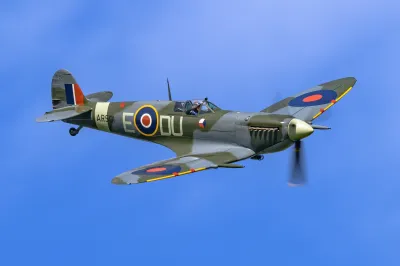
Thursday 5 March 2026 marks the 90th anniversary of the first flight of the Spitfire, the WWII legend that played a key role in the Battle of Britain and D-Day. To commemorate this heroic aircraft and celebrate its engineering evolution throughout WWII, Shuttleworth is striving to get one of every airworthy mark of Spitfire in the country at its Summer Air Show on Saturday 25 July 2026. The Spitfire, with its ground-breaking design, gave the RAF a unique edge against the German Luftwaffe in the Battle of Britain. During D-Day, it was the Spitfire, along with other allied aircraft, that helped dominate the skies, powering the Allied push to free Europe from Nazi rule. Throughout the war, the engineering of the Spitfire evolved to make it an even more powerful fighter, resulting in 24 models (known as marks) being produced. Real WWII veteran aircraft Many of the exact Spitfires confirmed to be flying at Shuttleworth this summer saw real action in WWII, including:
- Supermarine Spitfire Mk Ia N3200 was shot down during the evacuation of Dunkirk in May 1940 and had to ditch on Sangatte beach.
- Supermarine Spitfire Mk Vc AR501 was issued to both No 310 and No 312 (Czech) Squadrons during its active service and even escorted the Boeing B-17F Flying Fortress ‘Memphis Belle’.
- Supermarine Spitfire Mk IXc MK912 was heavily involved in missions during the build-up and aftermath of the Normandy landings.
- Both Supermarine Spitfire PR.XI PL983 and Supermarine Spitfire PR.XIX PS853 in their distinctive PRU blue colours were used for photo reconnaissance, taking images behind enemy lines.
- Supermarine Seafire XVII SX336 was the naval equivalent of the Spitfire and is believed to have served with No 833 Naval Air Squadron.
The heroes behind the Spitfire’s success
The success of the Spitfire would not have been possible without its designer and test pilots. To celebrate the Spitfire’s designer, RJ Mitchell, Shuttleworth will be flying its de Havilland DH.60X which is the same model which Mitchell flew in to understand how flying works.
Test pilot Alex Henshaw was known for his record-breaking flights pre-war and flight tested approximately 10% of all Spitfires and Seafires ever built. Shuttleworth owns the exact Percival Mew Gull which Henshaw broke the London to Cape Town record in, so will be flying this aircraft amongst other types he flew in his memory at this display.
James Butt, Air Displays and Aviation Coordinator at Shuttleworth, commented: “Ninety years ago, the Spitfire took to the air for the first time before becoming influential in the course of WWII. Its design and performance were exceptional for its time and remain impressive even today. The fact that visitors are still excited to see and hear a Spitfire flying at our air shows is a powerful reminder of its enduring legacy, and we’re proud to help preserve this history for future generations.”
About the Spitfire
The Spitfire was strategically important in WWII, and was used as a fighter, interceptor and reconnaissance aircraft. Its design was revolutionary for its time, with outstanding agility and speed. Its first flight took place at Eastleigh Aerodrome in Southampton on 5 March 1936, piloted by Joseph "Mutt" Summers. The Spitfire was key to the protection of British cities from bombing in the Battle of Britain and ultimately deterred Operation Sea Lion (Nazi Germany's code name for the planned invasion of the UK).
All aircraft appearances are subject to weather and serviceability.
For more details on Shuttleworth's 2026 events and how to book, visit: https://www.shuttleworth.org/events